Friday, May 14, 2010

Readers at The Tobin School love Charlesbridge

About a month ago, Charlesbridge received some great feedback from the readers whose opinion matters most--children! Ms. Rosalind Pelletier's third and fourth grade classes at The Tobin School in Natick, MA had some wonderful things to say:


Dear Charlesbridge,

I am Erin and I want to say we love your books. I am in third grade at The Tobin School. The books I liked that you published are Different Just Like Me by Lori Mitchell and Diary of a Would-be Princess by Jessica Green. I am inspired by your editing, clear prints, and illustrations. I also like how the books were written. I loved how in the book Different Just Like Me everyone was different and it was okay. I loved Diary of a Would-be Princess because it was hilarious and it taught me a whole lot! I also was surprised when Jillian got the school citizenship award.

You guys and gals have excellent talent.

Sincerely,
Erin

_________________________


Dear Charlesbridge,

Hi. My name is Drew. I am in third grade at The Tobin School. My teacher loves your books! My favorite books are Diary of a Would-be Princess by Jessica Green, Alice and Greta by Steven J. Simmons and illustrated by Cyd Moore, and Our Seasons by Grace Lin. I like them because they're funny, cool, and adventurous. I hope you have a fun time in business!

From,
Drew

_________________________


Dear Charlesbridge,

My name is Amelia. I go to The Tobin School. I am in 3rd grade and I'm 9 years old. I loved the way you guys published
Diary of a Would-be Princess by Jessica Green. Happy publishing!

From,
Amelia

_________________________


Dear Charlesbridge,

My name is Gus. I am in fourth grade. I go to The Tobin School. My teacher Ms. Pelletier really likes your books. My favorite book that you have published is Diary of a Would-be Princess by Jessica Green.

From,

Gus

P.S. I loved the book because it was funny.

_________________________


Dear Charlesbridge,

I am Jared. I am in third grade and I go to The Tobin School. Thank you for publishing all these great books. My favorite one is Dairy of a Would-be Princess. My favorite part is when she wins the speaking contest. Thank you!

From,
Jared

_________________________


Dear Charlesbridge,

I am in 4th grade at The Tobin School. Thank you for publishing all those wonderful books. I especially like Alice and Greta by Steven J. Simmons. I love it because it's so funny and teaches a good lesson. Thank you again.

From,
Sophie

_________________________


Dear Charlesbridge,

My name is Shidong. I am 9 years old and I am in 3rd grade. I go to The Tobin School in Natick, MA. My teacher loves your books. We read a book that you published called Diary of a Would-be Princess by Jessica Green. We also read a book called Many Biomes, One Earth by Mr. Collin [Sneed B. Collard III]. What I liked about Diary of a Would-be Princess was it was so hilarious. I thought the book Many Biomes, One Earth was very educational about what the biomes look like and animals' habitats. I hope I can see some of your other books!!

Sincerely,
Shidong

_________________________


Dear Charlesbridge,

My name is Emily, I am in 4th grade and go to The Tobin School. Thank you for publishing all these great books!! My favorite was In My Own Backyard by Jud Kurjian. We used it for social studies. Please write back soon.

From,
Emily

P.S. I liked the book because it shows how the earth changed.

Tuesday, May 4, 2010

Going to Mars

It was the summer of 2007 and I had a book to write. The time had come--no more stalling: "Let's wait a little longer and see what happens up on Mars." That had been my excuse for two years. The Mars Exploration Rovers had landed in January 2004, their mission planned to last ninety days. Then I was to write the book. But the rovers didn't break down or even stop, and the mission went on, and on, and on, and on (and it's still going as I write this in 2010).

In 2007, I had plenty to write about. Tens of thousands of images and an immense amount of scientific data had been sent to Earth, and scientists were forming a detailed geologic picture of the planet. All along I had followed the mission, checking in on the progress of the rovers via NASA's websites, press releases, and publications; reading scientific and technical articles; and devouring the latest books by Jim Bell and Steve Squyres (the main guys behind the mission), calling them at their offices at Cornell University.

But enough--surfing, reading, talking, thinking--it was time to write! Trouble was, I had just experienced a major life change that was only going to get more challenging. In June 2007, my family and I moved to New York State after two years in Anchorage, Alaska. My father was terminally ill and needed care. The moment I stepped off the one-way Alaska Airlines flight into Newark, I became his primary caregiver. (Did I mention that I had four children--ages 8 to 18 at the time--who were not thrilled about the move?) Before confronting the overwhelming task of registering children in new schools, organizing medical care, and learning everything there is to know about catheter bags, my family and I went to the beach for a one week vacation. I brought along my Moleskin© with the idea of beginning my book. This is what I wrote:

I am on an island, on a beach, fishing. The sun has set, but the sky is still pink on the edge. A bell rings constantly from the point of the land that curves into the sea. People line the shore, some wade into the channel, casting into the darkness. Behind me the Moon is up, a crescent in the sky, and nearby a bright dot shines steadily--Venus, I think. Mars is somewhere out there, too. I am trying to imagine myself there, on a distant land, where there is no ocean and where the daytime sky is always pink. If I were there, I'd be bundled in a spacesuit with no chance of actually touching the land with my fingers, or feeling its bitter dry wind in my face. So, how do I write about this distant place--my only reference the postcard photographs taken by little cars that carry cameras and rove its surface? How do I write about a place where I have never been, where no one has ever been?

S0 the next day, while sitting on the beach, these words popped into my head: cars on mars. That was it, of course! That was the title--it was so obvious, yet it had taken more than two years to materialize in my mind. Suddenly, I had something familiar to work with. . .the rovers were like cars on a road trip. And I'd had a lot of experience with road trips--Colorado to New York, New York to California, California to New York, all of Ireland, and the biggie--New York to Alaska on the Alaska Highway, through British Columbia and the Yukon.

As one always does before a road trip, I made lists:

things to take on a road trip
good tunes for a road trip
snacks and drinks for a road trip
signs encountered on a road trip
things to do before leaving on a road trip
famous phrases containing the word "road"
things people say when on a road trip

I sketched out a book dummy, complete with talking rockets, signs, arrows, and a new-car sticker (now that was shocking). My Moleskin© was filling up.

But when we returned home from the beach I was immediately confronted with the enormity of my task (my father, not the book). My father, although 86 years old, gravely ill with prostate cancer, heart failure, kidney failure, and dementia, informed me that he was not planning on dying.

Writing Cars on Mars became my escape from the demands, complexities, frustrations, fatigue, anger, and grief of caring for my father. When I sat down at the computer, I felt like I was buckling my seat belt and leaving everything behind. What a grand road trip it was! Spirit and Opportunity were my cars, my personal ride. We traversed another world, discovering rocks and soil named after girl baseball stars from the forties (my father was the one who taught me to love the game), climbing hills (my father was the one who taught me how to drive a stick), and descending into craters (he also taught me how to ski). I spent three weeks in a coffee shop (no kids, high speed internet, and endless coffee) pouring over the astonishing high-resolution digital photos taken by the rovers to the soundtrack of The Grateful Dead, The Doors, Led Zeppelin, and The Rolling Stones (just like a real road trip).

I worked on the manuscript into the spring of 2008. I'd transported my father to the hospital and doctors' dozens of times for falls, catheter bag complications, heart failure, and blood transfusions. On the way home from one appointment I pulled into the grocery store and ordered him to stay in the car (he never liked being told what to do). I handed him a copy of the manuscript and told him to read it. I knew he would get bored quickly and then get out of the car and wander into the road, so I raced through the store. When I returned he was still buckled in his seat reading. "Did you write this?" he asked. When I said I did, he asked again, "Did you write this?" (Dementia is like that.) Then he said, "This is fantastic. You wrote this? This is amazing. I hope you get paid for this."

When I was eighteen my father told me I couldn't be a writer. "They don't make any money," he had said. It took me a few years to accept that I didn't want to be a doctor or a lawyer (like he was)--but to be a writer, as I had dreamed. Cars on Mars: Roving the Red Planet was published eight months after my father died. It was my fifteenth book. But I will always think of it as the book that made me a real writer--in the eyes of my father. That means a lot.


Posted by Alexandra Siy, author of Cars on Mars, Sneeze, Mosquito Bite, and Footprints on the Moon.

Thursday, April 1, 2010

A Poet Makes A Laughing Sound

In honor of National Poetry Month I would like to write a bit about how my poems come to be. I have always loved words, and I have written poetry since I was fairly young. I remember writing poems in fourth grade, probably my first conscious attempt to be a writer. I think they were about horses.

Here is a poem I wrote in high school that got published in our literary magazine:

Well

Deep, dark, damp, and dank
Smooth stone on smooth stone;

Hollow cylinder, receptacle of Earth's tears.

Hairy beard so sopped with ooze
Dripping, dripping, dripping, dropped.

Ringed rings rolling, rolling

Strike the mossy walls with silence.

Deep, dark, forgotten, lost;

Stones of earth laid by man
Worn and worn and worn again,
Cold, rejected, forgotten, hidden
at the base of trees' naked roots.

Home of rat, spider, and dead mole.

Dripping drops of liquid rock

Dark, forgotten cylinder, receptacle of Earth's tears.


Reading this poem now it reminds me of how much I like the feel, the taste of words. I must have just discovered alliteration as a poetic device. I wrote with rhythm, and I was thinking in images. My poems today are not a whole lot different--I look for rhythm. I taste the words and feel the flow of the words physically as I write them. I think about images.

The poem "The Robin Makes A Laughing Sound" grew out of a walk. I was walking home on a March evening, listening to the bird sounds. A funny noise, soft, yet sudden, made me stop. It reminded me of my neighbor's guinea pigs, the sort of noise they make. I looked around and spotted a robin. I began to think about how to describe the sound the robin had made. This was not its song. This was a kind of call, perhaps a warning. The best I could come up with was a laughing sound. "The robin makes a laughing sound. " Those words fit with the rhythm of my walking. By the time I walked all the way home I had four lines, the beginnning of a poem:

The robin makes a laughing sound
Reminding me to look around

At buds on twig tips swelling big

And swelling worms which robins dig.


The words came naturally as I thought about what I had just experienced. I wrote them down in my journal.

A few days later I came back to the idea. More lines came to me as I revised my first thoughts:

The robin makes a laughing sound
It makes me stop and look around

To see just what the robin sees--

Swelling buds on twigs of trees--

A nice high branch on which to rest
A nice safe ledge to hold her nest.

The robin makes a laughing sound.

I always stop. Look around!


a little kitten says meow
the robin isn't laughing now.


Sparrows in a privet hedge--


Seagulls like dumps and garbage and hang out at the mall

About here I realized I was getting sidetracked, but I had found a rhythm I liked. So I abandoned the last four lines that digress from the idea of the robin. My poem was almost complete. I had circled the two uses of the word "nice" in my journal. Nice is a pretty generic word unless you are trying to make a point about the word nice. What kind of branch would a robin like? What kind of ledge? Also, the line "Swelling buds on twigs of trees" seemed difficult to say out loud.

Here is how the poem looked when I submitted my manuscript:

The Robin Makes a Laughing Sound

The robin makes a laughing sound.
It makes me stop and look around

To see just what the robin sees--
Fresh new leaves on twigs of trees--
A strong high branch on which to rest--
A safe, dry ledge to hold her nest.

The robin makes a laughing sound.

I always stop. Look around!


My poem was almost complete--there were just a few editorial changes: the punctuation was changed to make the poem easier to read. And the last line shifted slightly. Instead of ordering my reader to look around, I kept the line within my own experience--"I stop. I always look around."

The Robin Makes a Laughing Sound

The robin makes a laughing sound.
It makes me stop and look around

to see just what the robin sees--

fresh new leaves on twigs of trees,
a strong, high branch on which to rest,
a safe, dry ledge to hold its nest.
The robin makes a laughing sound.

I stop. I always look around.


"The Robin Makes A Laughing Sound" took only two drafts to reach its essential shape. Other poems were harder to get at.

I liked the line and the idea of seagulls hanging out at dumps and malls. I live in the Midwest, near Lake Michigan, but 1,000 miles from the ocean. Yet I see gulls all year round. I see them most often when I drive down North Avenue, past mall after mall. The gulls are everywhere, perching on street lights, soaring over the parking lots. Why are they here? I began to think about my experience with gulls. Gulls are hard to identify so I used the not quite proper term "seagulls" which encompasses many different species. I wanted to emphasize how out of context the gulls seemed. This was one of my early drafts:

Seagulls

Seagulls like dumps and garbage.
They hang out a the mall.

There is no ocean here for a thousand miles.

But there are lakes an rivers that run to the sea.
And garbage and dumps and malls.

Seagulls make loud noises--

They're not shy. They are the teenagers of birds--

Showing off, making noise,

Traveling in packs. But always competing.

Just like the boys in junior high who hang out at the mall.


One reader suggested that I concentrate on the secon stanza and develop the idea of seagulls as the teenagers of birds. Although I like the idea of gulls living so far away from oceans, I felt it was a good suggetion for bringing some unity to the poem. Here is the version that I submitted in my manuscript:

Seagulls

Seagulls are the teenagers of birds.
They hang out at he mall,
Scrounging for French fires and scraps of burgers.

They laugh. They swoop. They're not shy.

They travel in packs, squawking, playing at tug of war over crumbs,
Just like the boys from middle school,

Who hang out at the mall.


I like the poem and I really liked the comparison of seagulls to kids, but I felt the poem was too literal, too direct, lacked style. I continued to work on it as the book went into production. My "ah-ha" moment was when I realized that I did not need to tell the reader that seagulls are the teenagers of birds--the poem shows that comparison through it's actions. So I dropped the first line and opened with the second. I played with the order of the lines and images until I had simplified the poem. My editor suggested that all the verbs used should be able to apply equally to kids and birds, so "swoop" was out. "Strut" replaced it. The final suggestion, which I am still second-guessing, was to eliminate the last line. It has a repetitive, plaintive note that I like and that my editor and my writer's group felt was unnecessary and did not contribute to the poem. I still miss it.

Seagulls

Seagulls hang out at the mall.
They laugh. They squawk. They strut.

They're not shy.
They travel in packs,
fighting over french fries
and scraps of burgers--

just like the kids from middle school.


What do you think? Should this poem end with the lines "just like the kids from middle school/who hang out at the mall."?

Posted by Sallie Wolf, author/illustrator of The Robin Makes a Laughing Sound.

Friday, March 5, 2010

Spotlight on: Mary Corcoran

With a new book out this spring, Mary Corcoran is finding herself the object of TV interviewers affection. Yesterday she was a guest on Better Connecticut, a local TV program on WFSB Channel 3. The former seventh grade science teacher talked about her two books with illustrator Jef Czekaj, The Quest to Digest (2006) and The Circulatory Story (February 2010). Click here to see the full interview.


"This is a well-illustrated book that both kids and adults will enjoy. The Quest to Digest is an easy, fun, interesting, accessible, entertaining account of the digestive process."
-- Science Books & Films


Praise for The Circulatory Story:

"An irresistible invitation to go with the flow."
--Booklist

Monday, March 1, 2010

The Recipe for an Ocean Soup

Once a park ranger, always a park ranger. Fresh out of college, I worked as a National Park Service ranger. I loved "teaching" or interpreting natural history to park visitors.

One August almost ten years ago, our Vermont family piled into our beat-up Toyota Previa van and drove the six hours to the coast of Maine. We landed in a tiny coastal harbor in a village called Blue Hill. The rental cottage overlooked a narrow tidal inlet. We would be there for the week. E.B. White, the author of many books including Charlotte's Web, Stuart Little, and Strunk and White's Elements of Style, lived in Brooklin, Maine, just up the road.

The tide pools at the edge of this little Maine cape would provide the inspiration for one of my children's books many years later. A half-mile section of tide pools spanned our front yard, less than 100 feet from the deck of the rental house. At low tide, mid tide, and high tide, I would go exploring. I'm a Vermonter. We have no ocean. So this was like Disneyland for a naturalist.

I'd often take our two daughters, Hayley, 12, and Devon, 10, to investigate the pools. We'd creep over the rocks and peer into the still water. The life in the quiet, salty pools fired my imagination. It was like looking into someone's living room. Everyone was home: anemones, barnacles, starfish (now called sea stars), crabs, sculpins, sea urchins. For five days I watched their comings and goings, prying into their private lives. I scribbled notes. I took photographs. I stayed long after the girls got bored. I'd studied tide pool ecology in a Field Biology course in college a million years ago, so this felt like meeting up with old friends.

As a writer, you have to be ready for inspiration when it shows its face. We returned to Vermont, shook the sand out of our sneakers, and stored our beach gear in the barn. And then every morning for the next two weeks I woke at five, went to my desk, and wrote poems about tide pool creatures. I browsed field guides. I stared at the shells we'd collected. Sniffed the salty carcass of a sea fan. And with the promise to myself that I would keep B.I.C (Butt In Chair) until I had written something, I began to hear the voices of the tide pool inhabitants.

I wanted Ocean Soup to work on two levels: poems that were entertaining and educational, and solid factual information that would enlighten and expand awareness about a beautiful and threatened habitat. Besides a glossary and further resources to explore, I wrote brief factoids about each critter.

I don't know exactly how and when Ocean Soup became poems rather than straight nonfiction text, but the writing emerged as poems right from the start. And I knew that they had to be funny. I wanted the creatures to speak for themselves. A starfish with attitude. A sea urchin proud of its spines. A blue mussel tired of being pushed around. I envisioned the sculpin first as Fagin in Oliver! and I just knew that Hairy Doris, a sea slug, was Mrs. Doubtfire.

Shortly after completing the book, I began "performing" some of the Ocean Soup poems in conferences around the country. They were so well received, I thought there might be an opportunity to take it further. During a conversation with my savvy and tech-loving nephew, an idea was born to videotape me performing the poems in an actual tide pool. So on a warm weekend in late August, we drove three hours to Odiorne Point in Portsmouth, New Hampshire.


The filming of the Ocean Soup videos was a total blast. My wife, Heather, held the cue cards and boom microphone and my nephew, Sasha, filmed the action with an HD digital camera. I dressed as a pirate, and English school boy, a well-endowed hussy, a nightclub performer. I poked around thrift shops and found a dapper white and blue seersucker jacket. We filmed in morning and late afternoon light. The staff at Seacoast Science Center were a great help suggesting locations to shoot and even providing us with some "tame" tide pool critters.

I feel like this book, these poems, have taken on a life almost all their own. I love Mary Peterson's colorful and playful illustrations. They complement my text perfectly. And to cap it all off, I'm very proud of the dynamic and whimsical website we've developed at www.oceansoupbook.com. So from the first time I peered into a marine tide pool all those years ago, to the creative energies I poured into the writing, performing, and promoting of the tide pool poems, what a long, fun trip it's been.


Posted by Stephen R. Swinburne, author of Ocean Soup.
Watch Steve's Ocean Soup videos here!

Tuesday, February 16, 2010

The Day-Glo Brothers Recognized Again!


It's hard not to notice The Day-Glo Brothers--that bio/science book about the two brothers who invented Day-Glo colors and changed the world. So, naturally, the bloggers of the kidlitosphere--an intelligent and talented bunch of writers--noticed not just how the colors pop, but how human this story really is: two brothers, a couple of dreams diverted, and an accident and what you get? A Cybils Nonfiction Picture Book Award.

Sally Derby Launches Kyle's Island

On February 2nd, Sally Derby launched the release of Kyle's Island at The Blue Marble Bookstore in Fort Thomas, Kentucky. Dave Richardson, of The Blue Marble, said, "It was fantastic... and even though things were crowded, no one complained."

Enjoy these pics:


Monday, February 1, 2010

Every Boy Needs an Island

At the outset, let me acknowledge that I have no research to back up the statement above. No scientific studies to cite; I haven't even taken a poll. My only authority comes from my having raised seven boys, all of whom, I'm glad to say, are happily married, gainfully employed, and still speaking to me on a regular basis. (I am also the mother of a lovely, intelligent daughter, but her story will have to come at another time.) I acknowledge, too, that not everything I say here will be true of all boys, and that some of my observations will apply to girls too. Still...

When my first child was born, I was disconcerted to learn, as I swam groggily to consciousness, that I had given birth to a boy. Of course, I'd known this was theoretically possible, but since I had no brothers, no neighborhood boys to play with as a child, and had gone to a woman's college, I kind of assumed that God would know I wasn't equipped to be the mother of a boy. Let alone another boy. And then another, et cetera, et cetera, until my sons numbered five (I'll get to the seven part later).

As my sons grew older and their number increased, I made some interesting observations. Number one: No matter what the intended purpose of a toy might be, a boy would immediately consider it something to take apart, to use as a hammer or a drumstick, or to convert into some sort of milita
ry weapon.

Number two: Boys are incapable of holding still. I am convinced that as grade-schoolers, were such diagnoses then available (along with their pharmaceutical remedies), my boys would all have been labeled hyper-active, overly distractible, and possibly of below average mentality. In view of their later achievements and those of a number of boys I have tutored, I've come to the conclusion that boys should always start school a year later than girls, and that they should never be expected to sit quietly for more than ten minutes at a time until they reach the age of maturity, which is usually about forty-six. (Sometimes older)

Number three: Boys occupy at least twice as much space as girls do. Watch a group of three or four girls. They can entertain themselves for hours just sitting on the top of a stoop with books or crayons or dolls. During the same amount of time, boys will need the front and back yards of four or five houses, preferable furnished with trees for climbing, bushes for hiding in, and one or two areas where
digging is allowed.

My oldest son was thirteen and my youngest two when I realized that these boys were not meant for suburbia. They needed space to stretch their burgeoning wings. I thought a house surrounded by four or five acres of woods would be just about right. Unfortunately, acreage of that size in or close to Cincinnati was more than our budget could handle and I couldn't convince my husband of the advisability of a move to Australia where there was still that whole lovely Outback to explore.

We compromised by selling our five room ranch-style house at a loss (something IRS agents found unbelievable - obviously none of them had ever seen what five boys can do to a house), and moving to a three-story Victorian on the other side of town.

For a while, exploring a new neighborhood provided sufficient outlet for the boys' need for adventure, particularly after they realized that they could tell me they were going to a perfectly acceptable park where, unknown to me, a slight depression under the fence allowed them access to the siding of a railroad in active use.
(Just an asi
de: I've written a middle grade novel in which the young protagonists engage in a few of the hair-raising escapades I've since learned the boys somehow miraculously survived...Editors, envisioning I suppose, hundreds of letter from horrified mothers, have told me that such activities are far too dangerous for suggestible young readers. What I feel is that it's hard to suggest something dangerous and exciting that boys haven't already thought of.)

What drove this need to explore, to test limits, to court danger? Were my sons so very unusual? I worried about this for years until through a series of freakish occurrences, two more boys joined our family. They were brothers, one twelve at the time, the other fourteen - ages that fit nicely into the middle of the boys. It was only a matter of months until, as a foster mother, I realized it wasn't a lack of parenting skills on my part that made my sons bundles of curiosity and adrenalin. It had something to do with the drive that long ago had propelled one particular sperm to beat the others in the race to the egg.

So what h
as this to do with boys and islands? In Kyle's Island, I have tried to show that boys need an unexplored place beckoning to them. For Kyle, if he can explore the island, he can satisfy his need to find a place not already known, defined, and reduced by grown-ups. The nondescript island in the middle of a small lake in Michigan is Kyle's Bali Hai, his Shangri- La, his Ultima Thule.

This restlessness of boys, this drive to explore, to master - I've seen my sons wrestle with it. I've watched some inner-city boys turn sullen and hopeless because they could see no island on their own horizon. My heart aches for them and for the boys whose only outlet for their restlessness consists of overcoming obstacles to attaining a higher level on a video game.

I know we can't go back to the days when unexplored frontiers were part of every boy's landscape. I know that not every boy can realistically hope to become an astronaut, a mountain-climber, or a deep-sea diver. But I hope that parents and teachers will recognize, honor, and try to accommodate the inherent restlessness that is part of every boy's make-up instead of trying through discipline or medication to transform boys into "well-behaved" counterparts of their sisters.

Let's watch and applaud a young boy's search for his own island, no matter how different it is from what we dreamed of for him. And if we are lucky, some day he will come back and say to us, "Hey! I want to show you what I've found!"


Posted by Sally Derby, author of Kyle's Island.

Friday, January 22, 2010

ALA Midwinter in Boston

Don't call it Beantown. It's "America's Walking City" and it is our understanding that on Saturday, January 15th, you could walk around town quite comfortably during our January thaw. We wouldn't know. We were tucked away underground in the Boston Convention Center (the fairly new big boy of convention centers), enjoying the warmth of librarians.

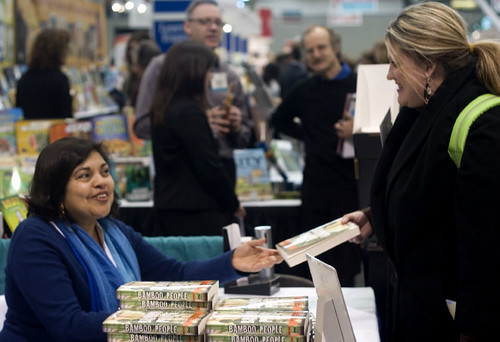
While it may have been 40 degrees outside, it was hot in the aisles. And it was wicked hot ("wicked" is a popular word in New England that means "really, really"), at the Charlesbridge booth with authors like Mitali Perkins and Lynn Plourde signing.

At left is a photo of Mitali signing copies of the ARC of her upcoming novel, Bamboo People (July 2010). Notice Angus Killick and friends hovering Zelig-like for photo ops.

(Photo from American Libraries Photostream)


But the most exciting part of all -- as always -- was Monday morning and the awards announcements. This year Charlesbridge got to scream real loud (just like on Pee Wee's Playhouse). The Day-Glo Brothers by Chris Barton and illustrated by Tony Persiani, was named a Sibert Honor Book. Fantastic to be in our own backyard and to be able to have people in the hall to holler (despite the now-bad weather) because it's just sad when it's just the two of you. And what a great dollop of cream filling for a cupcake of a year for that most awesome of books.

Speaking of cupcakes... whenever anything remotely good happens at Charlesbridge -- a book wins a major award, someone has a baby, a brand new episode of Lost -- the staff at the Bridge tends to celebrate. Never met an office-full of people so ready to stop, drop, and gather in the conference room for some chips and dip. Or, in this case, Day-Glo cupcakes. With champagne (surprisingly not a bad combo). There was orange juice for mimosas for those that don't like their alcohol straight up first thing in the morning. We're "rock stars", not rock stars.
(Don't they look disgusting and possibly toxic? But, Duncan Hines! Don't mess with perfection)


Look at them all ogling those tasty cakes. Wait, now, everybody. You'll be told when you can dig in.


At left, the creative team, who put the "day" in Day-Glo. The uncreative team toddled off to seek out more cerebral pursuits.


And MORE good news! The Importance of Wingsby Robin Friedman is the WINNER of the Sydney Taylor Book Award. Congratulations, Robin! Well-deserved.

"Friedman does an exquisite job in bringing the two older girls to life" - Booklist

"[A] voice that is both sardonic and sincere..."
- Kirkus Reviews


"...middle school angst, first crushes, and the importance of finding one’s own wings." - School Library Journal


Find out more about The Day-Glo Brothers and The Importance of Wings at www.charlesbridge.com.

Monday, January 4, 2010

"Story is Forever"

Story. Tradition. Love. The family of our heart as well as of our blood and bone.
These are what motivated my to write my picture book, What Will You Be, Sara Mee? These are what
made and continue to make me want to share my experiences with others.

Family...
When my daughter, whose name really is Sara Mee Jung Kim, arrived at the San Francisco airport from Korea on September 14, 1984, she was exactly, to the day, fourteen months old. Our whole family was there, waiting for the plane to land--all watching out the big window toward the runway. I walked down a long corridor to the door of the 747 jumbo jet. When the escort placed Sara Mee in my arms, she was wearing a light green terry cloth sleeper. And she was crying. I spoke gently to her in Korean, Mee Jung ah, ool jee mah. She stopped crying instantly and looked up at me with a big smile. I carried her back down the long corridor where the rest of her family--Daddy, big brother, Grandma and Grandpa--met her for the first time. There was a lot of hugging and crying, crying and hugging. The story of our life together as a new family had begun. That story, like any story, has had many chapters. Joyful chapters. Funny chapters. Suspenseful chapters. And tragic, sad chapters. But all the chapters tell a story of love that has been enriched by sharing a diverse wealth of...

Traditions...
We were one big multicultural family even before Sara Mee's arrival. A joyful, eclectic blend of European, Celtic, Ashkenazi Jewish, a bit of Native American. When I was in high school, Mariko, an AFS exchange student from Japan lived with us for a year. She and her family became a part of our family and added many more rich traditions and, to date, over forty years of sharing stories and visits, one continent to the other. We celebrated pretty much everything throughout the seasons. With Sara Mee's arrival, Korean culture and customs were woven into the cycle of our lives. Even though she was just past one year old, we decided to have a "Tol," the ritual first birthday celebration featured in What Will You Be, Sara Me? Our dear Korean neighbors, the Yees, helped us plan the Tol and prepare for the Toljabee, prophecy game. Just like in the story, we invited friends and family and neighbors. Just like in the story, everyone ate and talked, laughed and gathered to see what Sara Mee would be. Should I tell what symbolic item she chose? What her prophecy was? No, I think I'll let everyone wonder and only hint that though my story is based on real experience, it is also fiction. And, it is autobiographical like most stories are at least in part. Within its pages I have been able to immortalize my daughter and my son, to continue their sibling relationship even though he died long ago. Story. Story is forever. And so is love.

Story...
I have been writing as long as there was paper and pencil or crayon or pen available to grab onto. Recently, I found several of my childhood books that have illegible pencil scrawl under the printed lines. I was writing or maybe re-writing all those years ago! I wonder if revision was easier then. It is most assuredly the hardest part of the writing process for me now. The writing process itself is very thrilling, especially when a new idea kindles my thinking, or characters come alive and seem to be telling the story themselves. Story. And poem. And song. Discovered within the stories and poems and songs I have lived and heard.

Oh, and words themselves. Words and writing are a passion, an essential endeavor I "can't not do." I want to give this passion to the young, encourage them within this fast-moving, technological era, to keep listening and writing and telling the diverse stories of their world, their families, their traditions.

Happiness to all, whatever your prophecy may be.


Posted by Kate Aver Avraham, author of What Will You Be, Sara Mee? available February 2010.